Instructor
Python for Environmental Data Science
Master of Environmental Data Science (MEDS)
Summer 2026
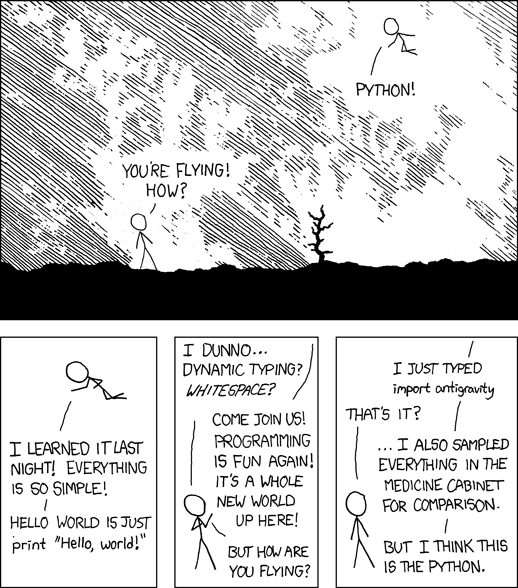
Cartoon by XKCD
Course Description
Almost every question you will ask of environmental data in this program needs code to answer it. Over nine days we build that code from nothing: writing Python, loading a dataset, reshaping the data into the form a question needs, and drawing the answer.
EDS 217 comes first in the MEDS program, and the courses that follow assume the Python we cover here. We work on real environmental datasets, in the tools environmental data scientists use, following the same data science workflow on every day of the course. By the end of the nine days you should be able to:
Read environmental data into a pandas DataFrame and inspect its structure and contents
Filter, sort, clean and transform a table to answer a question
Group rows and aggregate them into the comparison a question needs
Combine two tables, reshape between long and wide, and handle dates as objects
Build a figure in matplotlib or seaborn that demonstrates a pattern or relationship in data
Write your own Python: variables, collections, conditionals, loops and functions
Keep a Jupyter notebook in which every conclusion is matched to the cell that produced it
Work with a partner on a short piece of analysis, and present the result to the class
When we meet
Dates. Monday August 31 to Friday September 11, 2026. We do not meet on Monday September 7.
Hours. 10:00 am to 4:30 pm PT, Monday to Friday. We do everything in those hours, and you should not expect work outside them.
Questions. Ask in the MEDS Slack #eds-217-python channel rather than by email, because others usually have the same question.
Syllabus. The formal course policies are in the syllabus, which opens in Google Docs.
The workflow. Every day follows the same ten-step data science workflow, on a page that also says where in the nine days you learn each step. Worth reading once before Day 1.
Start with Day 1.
Syncing your classwork to GitHub
Your daily notebooks belong in a GitHub repository that you create yourself, in your own time rather than in class. Follow the directions for creating it before Friday of the second week.
The final project goes in a second repository, separate from your coursework. Day 9 covers what belongs in it, and the settings that differ.